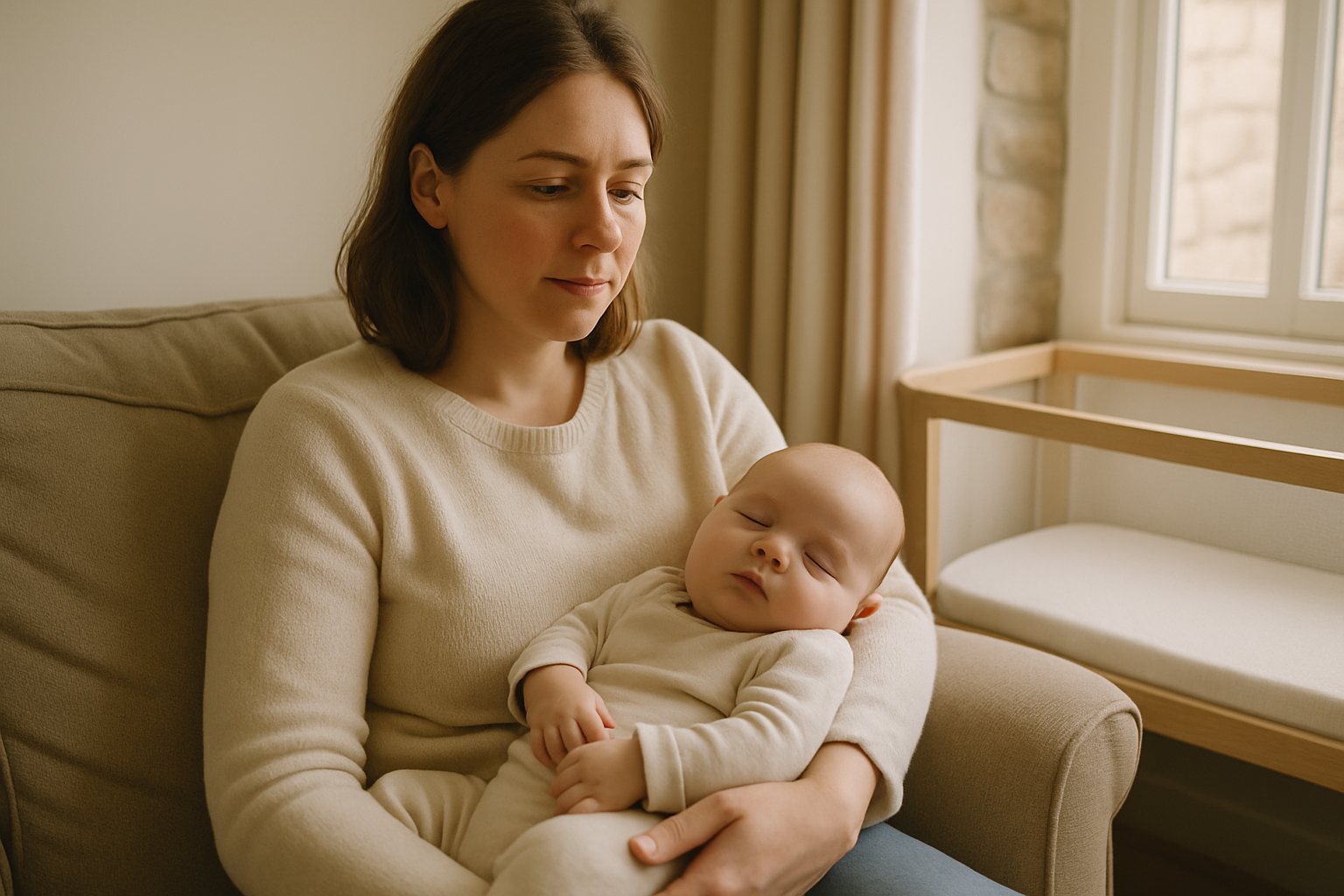
Newborn sleep can feel very different from the sleep adults are used to. In the first three months, babies often sleep in short stretches across both day and night, wake frequently to feed and show little interest in the routines adults might expect.
That can be tiring, but it is also a normal part of early development. Understanding the broad patterns can help you approach this stage with more realistic expectations.
Newborn sleep is spread across 24 hours
Young babies do not yet have an established day-and-night rhythm. Instead of having one long period of sleep overnight, they usually sleep and wake repeatedly throughout the day and night.
There is considerable variation between babies, so another newborn’s pattern is not a useful target for your own baby.
Sleep can also change from one day or week to the next as feeding, growth and development change.
Why do newborns wake so often?
Frequent waking has several ordinary explanations. Newborns have small stomachs and need to feed regularly. They may also wake because they need changing, comfort or help settling.
Their sleep cycles are different from adult sleep, and their developing body clock has not yet settled into a mature day-and-night pattern.
Frequent waking in the early months is therefore not, by itself, a sign that you have created a bad habit.
How much should a newborn sleep?
There is a wide range of normal sleep in infancy. Guidance about average sleep amounts can be useful as a broad reference, but individual babies do not necessarily match an exact number of hours.
Rather than trying to make your baby meet a particular total, pay attention to their feeding, alertness when awake, nappies and general wellbeing, alongside the advice of your midwife, health visitor or GP.
If you are worried that your baby is unusually sleepy, difficult to wake, not feeding as expected or seems unwell, seek advice from an appropriate healthcare professional.
Day and night may look similar at first
It is common for newborns to be awake at times when the rest of the household would rather be sleeping.
Over time, exposure to ordinary daylight and daytime household activity, followed by a calmer and darker environment at night, can help support the development of day-and-night cues. There is no need to force a strict schedule in the early weeks.
Short naps are common
Some newborn naps last for a substantial stretch, while others are brief. A baby may also appear to wake soon after being put down, particularly when moving between sleep cycles or after being transferred from someone’s arms.
Short naps are not necessarily a problem that needs fixing.
As your baby develops, their sleep pattern will continue to change.
What about contact sleep?
Many newborns settle readily while being held. Warmth, movement, smell and closeness are familiar and comforting after birth.
If your baby falls asleep while you are holding them, the important consideration is whether the adult holding them is awake and able to supervise safely.
If you feel yourself becoming sleepy, place your baby in their own safe sleep space. Falling asleep with a baby on a sofa or armchair carries a particularly high risk and should be avoided.
Keep every sleep space safe
Whatever your baby’s sleep pattern, safer sleep guidance remains important for naps as well as night-time sleep.
NHS guidance recommends placing your baby on their back to sleep in their own clear, separate sleep space, using a firm, flat mattress. For the first six months, their sleep space should be in the same room as you, day and night.
Keep the sleep space clear of pillows, duvets, cot bumpers, sleep positioners, pods, nests, toys and loose or padded items.
Current guidance should always take priority over photographs, social media posts or products marketed for baby sleep.
Do newborns need a sleep routine?
A strict sleep timetable is generally unrealistic for a newborn.
You can still create gentle cues around sleep, such as lowering the lights, speaking quietly or having a simple sequence before settling your baby. Think of these as familiar signals rather than a schedule your baby has to follow.
There is plenty of time for routines to evolve as your baby develops.
Protecting your own rest
Knowing that frequent waking is developmentally ordinary does not make it easy to live with.
Where possible, sharing practical tasks with a partner or another trusted adult, accepting help with meals and household jobs, and resting when opportunities arise can reduce some of the pressure.
If tiredness is making it difficult for you to care safely for yourself or your baby, speak to your health visitor, GP or another healthcare professional for support.
When sleep concerns are worth discussing
Parents are often told that newborn sleep is unpredictable, but that does not mean every concern should be dismissed as normal.
Contact your midwife, health visitor, GP, NHS 111 or another appropriate healthcare service if you are worried about your baby’s sleep alongside their feeding, breathing, temperature, alertness, nappies or general behaviour, or if something simply does not seem right to you.
The first three months are a period of change
Newborn sleep is not a finished pattern that you need to optimise. It is part of a rapidly developing stage.
Your baby’s sleep today may look different in a few weeks, and progress is rarely perfectly linear.
For now, focus on safe sleep, responsive care and realistic expectations. You do not need to teach your newborn to sleep like an older baby.
They are learning about day, night and the world around them gradually, and you are learning about them at the same time.